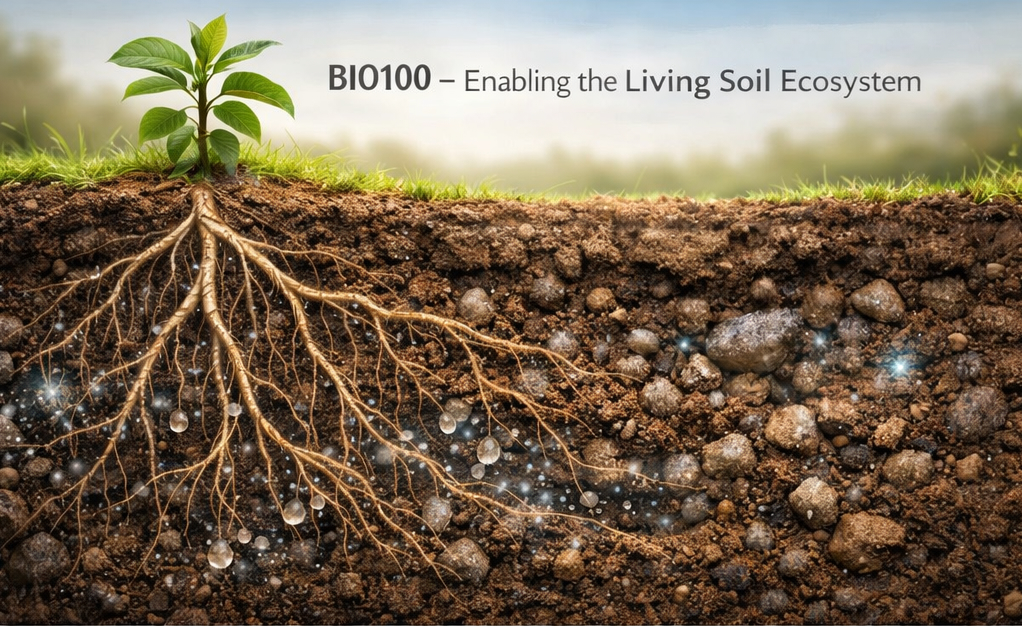
Living soil is not a resource. It is a system.
Everything that grows above ground depends on what happens below it. Roots, microorganisms, water, air, and organic matter interact continuously—forming a living soil ecosystem.
When this system is healthy, growth is resilient and sustainable. When it is damaged, surface solutions cannot replace what is missing.
All growth begins with living soil.
The Problem with Modern Soil
Modern soil is often treated as inert. Urbanization, compaction, and chemical dependency have stripped soil of its biological balance.
What remains may look like soil—but functionally, it is no longer alive.
The BIO100 Approach
BIO100 does not feed plants. BIO100 enables the soil that supports them.
By activating soil biology and restoring structure, BIO100 creates the conditions where roots and microorganisms can function together.
What a Living Soil Ecosystem Means
Healthy soil is not an inert growing medium. It is a complex, living ecosystem composed of billions of interacting organisms—bacteria, fungi, protozoa, nematodes, arthropods, and plant roots—working together as a self-regulating biological system.
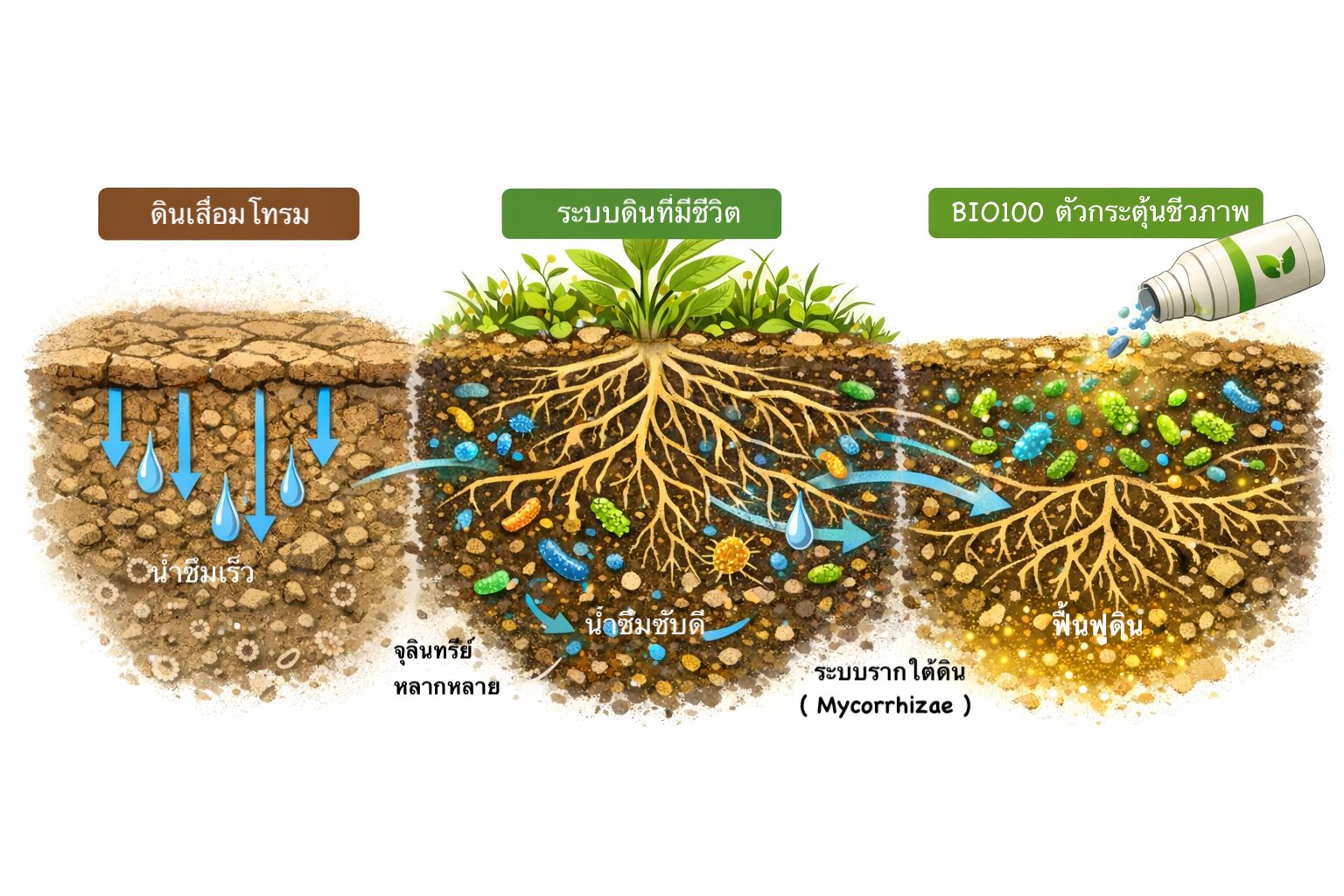
In a truly living soil, structure, biology, water, air, and nutrients are inseparable. Microorganisms bind soil particles into stable aggregates, creating pores that allow roots to breathe, water to infiltrate slowly, and nutrients to be retained rather than washed away. Mycorrhizal fungi extend far beyond root zones, acting as biological highways that transport water and minerals in exchange for plant-derived carbon. Beneficial bacteria fix nitrogen, solubilize phosphorus, and release trace elements that would otherwise remain locked in the soil matrix.
A living soil responds dynamically to its environment. It buffers against drought by holding moisture within its structure. It moderates excess rainfall by improving infiltration and reducing runoff. It suppresses pathogens naturally through microbial competition and diversity, reducing the need for chemical intervention. Over time, this biological activity builds organic matter, enhances carbon sequestration, and improves long-term fertility.
When soil life is depleted—through compaction, chemical overload, or repeated disturbance—the system loses resilience. Water drains too quickly or stagnates. Roots weaken. Nutrients become inefficient or unavailable. Plants survive, but they do not thrive.
Restoring soil, therefore, is not about adding more inputs. It is about rebuilding life, reactivating biological processes, and allowing the ecosystem to function as it was designed to—regenerative, adaptive, and self-sustaining.
Why BIO100 Exists
BIO100 exists to reintroduce and activate beneficial microbial functions that are essential to a healthy soil ecosystem but often missing in degraded or urban soils.
Rather than acting as a fertilizer replacement or a short-term stimulant, BIO100 is designed to support biological transformation. Its selected microbial communities perform specific roles that collectively improve soil performance over time:
- Soil structure enhancement: Certain microbes in BIO100 produce natural bio-polymers and binding agents that help aggregate soil particles. This improves porosity, reduces compaction, and creates micro-environments where roots and microbes can coexist effectively.
- Nutrient mobilization: BIO100 contains microorganisms capable of converting unavailable nutrients—such as bound phosphorus and micronutrients—into plant-accessible forms. This increases nutrient efficiency without forcing growth or creating dependency.
- Root–microbe synergy: The microbial strains are compatible with root exudates, allowing them to colonize the rhizosphere (root zone) and establish long-term biological relationships rather than temporary presence.
- Biological balance and resilience: By increasing microbial diversity and functional activity, BIO100 helps soils resist pathogenic pressure naturally. A biologically active soil favors cooperation over dominance, reducing stress-related plant issues.
- Water behavior improvement: As soil structure and organic interactions improve, water retention and infiltration become more balanced—reducing both drought stress and waterlogging.
Importantly, BIO100 does not attempt to “control” the soil. It enables conditions in which soil life can re-establish itself, interact, and evolve. The result is not instant visual change, but progressive, measurable improvement—stronger roots, healthier plants, more stable soil, and reduced reliance on corrective inputs.
BIO100 is therefore not an additive solution. It is a biological catalyst, supporting soil in returning to its natural state: alive, functional, and regenerative.
BIO100 – Enabling a Living Soil Ecosystem
Not by forcing growth.
But by restoring the conditions where life can grow naturally.